


If you’ve been keeping an eye on your certification path lately, you’ve likely heard the buzz: the CMA (Certified Management Accountant) exam is undergoing a significant evolution. Whether you are currently hitting the books or are just about to start your journey, understanding the CMA Exam Changes 2026 is the difference between a smooth finish and a stressful transition. For students seeking the latest updates, keeping track of CMA Exam Changes 2026 will help you strategize your preparation effectively.
Here is everything you need to know about the format shift, the “May vs. September” debate, and how to keep your budget intact while getting certified.
What Exactly is Changing?
The biggest shift involves the second half of the exam. For years, the traditional Essay format has been the standard. However, starting in 2026, the IMA is introducing Case-Based Questions (CBQs). With that in mind, staying informed about all CMA Exam Changes 2026 can help you feel more confident as the new format approaches.
When comparing the CMA Case-Based Questions vs Essay Format, the core difference lies in the delivery. While essays required long-form writing, CBQs use short business scenarios.
- Around 200–250 words
- A mix of calculations
- Multiple-select
- Drag-and-drop questions
Check CBQs Samples
Is the CMA Exam Getting Harder?
This is the number one question on every student’s mind: Is the CMA Exam Getting Harder? The short answer is: No.
The rigor, the content domains, and the global benchmark of the certification remain exactly the same.
The change is about modernization. CBQs are designed to mirror the real-world finance environment where you analyze data and make quick, accurate decisions. However, “different” can feel “harder” if you aren’t prepared, which is why many students are looking for CMA CBQ Sample Questions to get a feel for the new interface before it becomes the mandatory standard.
The Big Decision: May or September?
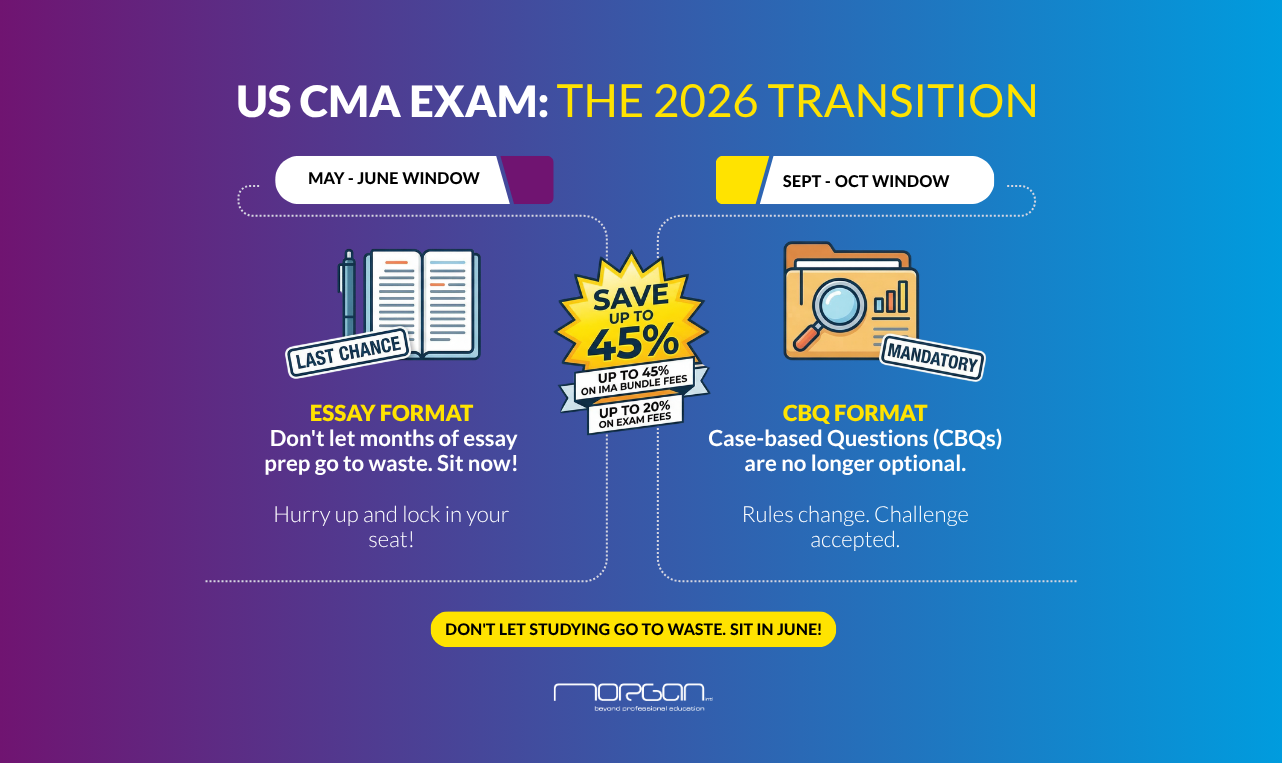
The May-June window is officially your Last Chance for CMA Essay Exam sittings. In this window, you actually have a choice between the traditional essay and the new CBQ format.
However, once we hit the CMA September October 2026 Exam Window, the choice is gone—CBQs become the mandatory standard. CMA Exam Changes 2026 will make this exam format transition official for all candidates in the September testing window.
Should you rush for May?
If you have already spent months practicing your essay-writing skills and “brain-dumping” your knowledge into paragraphs, yes. Rushing for the May-June window allows you to stick to the format you’ve already mastered. Don’t let your specific study prep go to waste by waiting for a format change that will require you to learn How to Study for CMA Case-Based Questions from scratch.
Do I Need to Re‑Register If I Want CBQs Instead of Essays?
Yes. If you already registered for the essay version of the exam and wish to transfer your exam appointment to the case-based version, you will not be charged a fee by ICMA.
The request must be submitted to the IMA no later than March 31, 2026.
Get 45% OFF
If the threat of a format change isn’t enough to get you moving, the financial savings should be. To support students during this transition, there are massive CMA Exam Discounts 2026 available right now.
Here is the breakdown of what you can save:
- 45% OFF the IMA Membership Bundle Discount (this includes your membership and the CMA entrance fee).
- 20% OFF your CMA Exam Fees.
These discounts are specifically designed to encourage students to sit for the exam sooner rather than later. By registering now, you aren’t just saving your study momentum; you’re saving a significant portion of your certification costs. It may also be your opportunity to experience the CMA Exam Changes 2026 with reduced financial pressure.
Final Call: Don’t Miss the Deadline
The clock is ticking on the traditional format. To ensure you get the seat—and the format—you want, you need to keep the CMA Exam Registration Deadline for the May-June Window in mind.
The CMA credential remains the gold standard for finance professionals, and whether you take the Essay or the CBQ, the value of those three letters behind your name is unchanged. But why make it harder (or more expensive) than it needs to be?
Ready to lock in your May seat and claim your 45% discount?
Click below to register with Morgan International and beat the September shift
FAQs
Here are some of the most frenquently asked questions about the 2026 CMA exam changes
What Is Changing in the Exam?
Beginning with the May/June 2026 exam window, the CMA® (Certified Management Accountant) exam will introduce case-based questions. These questions present short business scenarios (about 200 – 250 words) followed by a series of questions that assess how you apply concepts, calculations, and judgment to real-work situations.
Why is the IMA making this change?
The change reflects how finance professionals work today: evaluating business scenarios, interpreting data, and supporting business.
Will case-based questions change the rigor of the exam?
No. The CMA certification continues to include rigorous examinations. The content and expectations remain the same. IMA is evolving the content to ensure candidates can apply skills and knowledge in real-world situations.
Will my CMA credential be different depending on which format I take?
No. The CMA credential is the same regardless of whether you elect the essay format or the new case-based questions. Successful candidates who pass either version of the examinations and submit their required education and professional experience will both earn the prestigious CMA credential.
When does this take effect?*
For both parts of the exam:
May/June 2026: Candidates may choose either essays or case-based questions when they are scheduling their testing appointment. • September/October 2026: Case-based questions become the standard format.
*Excluding English and local language exams in China, Taiwan, and Japan
If I already began studying, do I need to change plans?
No. Everything you are studying still applies. The underlying concepts and learning outcomes remain the same. Your provider will gradually introduce case-based question examples as they become available.
If I fail a part during the transition, which format will I retake?
During May/June 2026, you may choose either format. After case-based questions become standard, retakes will follow the case-based format.
What Stays the Same?
The following will remain unchanged:
• Exam length, structure, multiple-choice questions, and price
• Content topics and learning outcomes
• Global rigor and recognition of the CMA
• IMA’s governance and standards
Do I need to buy new materials?
Your current CMA study materials align to the overall topics covered in the exam. Over time, providers may add case-based practice questions to augment your current valuable training, but you do not need to replace everything you already have.
Will my review course cover case-based questions?
Yes. Becker has already reflected the changes to their sample questions. Practice support is available too.
How should I prepare for case-based questions?
Focus on understanding concepts, not memorization. Practice explaining why a decision is appropriate, not just performing the calculation.
Will I see sample case-based questions before I take the test?
Yes. IMA and training partners will share examples so you can become familiar with the format.
How are case-based questions scored?
CBQs are scored consistently with CMA standards and emphasize accuracy, reasoning, and application. Details on scoring will be shared as implementation approaches
Can partial credit be awarded?
Where appropriate, partial credit may be awarded based on the scoring rules that apply to each question type.
What are the advantages of taking the case-based questions?
Case-based questions are designed to be concise and clear, focusing on applied prolem solving. The questions include responses to enable candidates to focus on their finance knowledge instead of writing an essay. This evolution supports IMA’s continued focus on best practices in testing globally.
Are there extra fees for case-based questions?
No. Exam fees are not changing as part of this update.
Will testing locations or proctoring change?
No major changes are expected. Candidates will continue testing through approved methods and locations.
Should I wait until after the change to start studying?
No. There is no reason to wait. Starting now keeps you moving toward completion, and your learning applies to both formats.


