


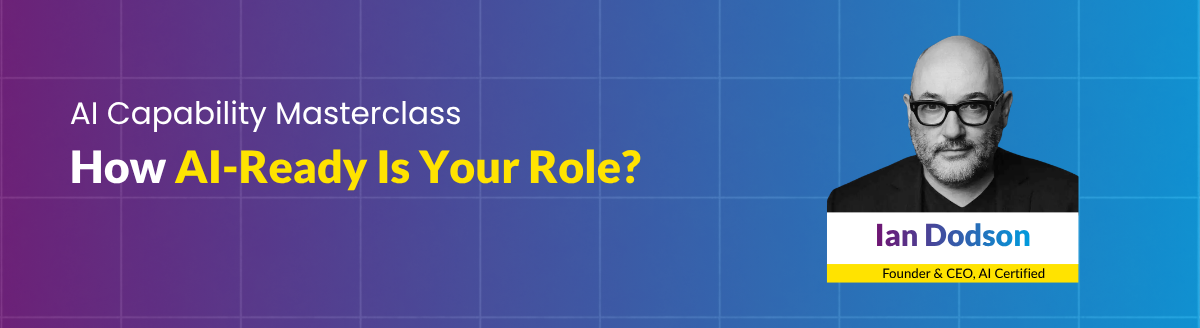
Everyone is being told to “learn AI.” But what does that actually mean for the work you do?
Do you need to become better at prompting? Learn how to automate parts of your work? Understand how to evaluate AI-generated outputs? Or, if you lead people or make decisions, do you need an entirely different level of AI capability?
These were some of the questions explored during How AI-Ready Is Your Role?, a live AI Capability Masterclass hosted by Morgan International in partnership with AI Certified, featuring Ian Dodson, Founder & CEO of AI Certified, and Fadi Ganni, Founder & CEO of Morgan International.
Rather than focusing on a particular AI tool or profession, the session explored a more useful question:
What AI capability does your role actually require?
Here are seven of the biggest takeaways.
1. Keep the human in the lead
AI can do increasingly impressive things. But that doesn’t make human expertise less important.
In fact, it can make it more important.
During the masterclass, Ian described AI as providing “rocket boosters” to existing human knowledge and competence. AI can help us work faster, explore information and generate outputs, but it is still human judgement that determines whether those outputs are accurate, relevant and appropriate.
AI is not a shortcut to expertise. It is also not truth, human thinking or a replacement for professional judgement.
The stronger your understanding of your field, the better equipped you are to question what AI gives you.
The goal isn’t human or AI. It’s human expertise amplified by AI capability.
2. Using AI is not the same as being AI-capable
Many professionals are already using ChatGPT, Copilot, Claude, Gemini or other AI tools.
Ian described this as the Experimenting stage: using AI for tasks such as writing, searching, summarising or getting guidance.
But access to AI doesn’t automatically translate into capability.
The next stage is Embedding — using better prompting and context, applying AI across multiple tasks and building more repeatable or automated ways of working.
Beyond that is Transformation, where AI starts changing the underlying way work and workflows are designed.
Experimenting → Embedding → Transformation
A useful question to ask yourself is:
Where am I today?
3. What you give AI matters as much as what it gives you
Getting better results from AI isn’t simply about finding a better tool.
The quality of the context, instructions, information and expertise you bring to AI has a major impact on what you get back.
As Ian explained, AI is probabilistic and based on pattern recognition. It can generate convincing outputs, but those outputs still need to be evaluated and validated.
That means AI capability isn’t simply knowing which buttons to press.
It means knowing what to ask, what context to provide and how to judge the answer.
4. AI becomes more powerful when you connect it to your own work
Generic AI tools can already help with a wide range of everyday tasks.
But one of the bigger opportunities comes when AI is applied to the information, workflows and data that matter to you or your organisation.
During the session, Ian highlighted the opportunity to work with your own data to generate more relevant and actionable insights.
The progression also moves beyond individual prompts.
Prompting and context can develop into automation, workflows and eventually AI agents, allowing professionals to think about AI not simply as something they ask questions, but as something that can support repeatable parts of how work gets done.
5. Your expertise still determines whether AI is useful
One of the strongest messages from the session was to “stay in your lane.”
That doesn’t mean limiting how you use AI. It means recognising that your professional expertise is what enables you to judge the quality of AI-generated work.
A finance professional can evaluate whether a financial analysis makes sense. An HR professional can question an AI-generated recommendation about people or talent. A marketer can judge whether an insight actually reflects the customer or market.
Ian cautioned that the risk increases when people use AI in areas where they lack the knowledge to recognise whether an answer is wrong.
AI can extend your capability. It doesn’t remove the need to know what good looks like.
6. For organisations, AI adoption starts with people
AI adoption isn’t simply an IT project.
During the masterclass, Ian argued that organisations need to push decisions closer to the work and enable the people who understand that work best to explore where AI can add value.
That doesn’t mean giving everyone unrestricted access and hoping for the best.
People need the right tools, guardrails, support, protection and guidance to experiment and use AI responsibly.
Ian introduced the A5 blueprint as one way of thinking about that journey:
Advocacy → Assistance → Automation → Agility → Advantage
The underlying principle is important: AI adoption begins with people, not systems.
7. Not everyone needs the same AI capability
This may be the most important takeaway of all.
Being AI-ready doesn’t mean everyone in an organisation needs to learn the same things or reach the same level.
Ian introduced a four-level capability diagnostic:
Awareness → Application → Accountability → Architect
- At Awareness, you may use AI occasionally.
- At Application, you use AI to produce work that others rely on.
- At Accountability, you approve or act on AI-informed work produced by others.
- At Architect, you design AI-enabled processes or tools that other people use.
- The further your responsibility extends, the more AI capability you may need.
So instead of asking:
“How much do I know about AI?”
Ask:
“What am I responsible for doing with AI?”
That is a much better starting point for deciding what you actually need to learn.
You don’t need more AI knowledge. You need the right AI knowledge.
One line from the masterclass captures the overall message particularly well:
“More knowledge is not better. The right knowledge is the solution.”
AI is changing too quickly for professionals to try to learn everything.
The goal is to understand what AI can do, where it can add value to your work, where human judgement remains essential and what level of capability your role actually requires.
And that will look different for different people.
For some, the next step is becoming better at applying AI in their own work.
For others, it is developing the capability to evaluate AI-informed work, make decisions around AI or support its adoption across an organisation.
And for some, it will be both.
So, how AI-ready is your role?
Ask yourself:
How am I using AI today?
Am I experimenting with it, or have I started embedding it into the way I work?
Do other people rely on work I produce using AI?
Am I responsible for approving or acting on AI-informed work?
Do I need to design or lead AI-enabled ways of working for others?
Your answers can help you identify where you sit today — and what capability you may need next.
Missed the live masterclass?
Watch How AI-Ready Is Your Role?, featuring Ian Dodson, Founder & CEO of AI Certified, and Fadi Ganni, Founder & CEO of Morgan International.
Ready to build the AI capability your role needs?
Explore the AI Certified professional pathways offered through Morgan International, with options focused on AI Application, AI Management and the complete pathway.
No coding or technical background is required.


